
Sailor Tattoos: A History from the Whaling City
Where traditional sailor tattoos came from, what the records actually show, and which meanings are sailor lore
Our shop sits in New Bedford's South End, near the harbor, in a city whose whaleships once sailed far past Cape Horn. So we get asked about sailor tattoos a lot: where the swallows and anchors came from, what a pig on the foot means, whether Captain Cook really "brought tattoos back." The honest answers are more interesting than the myths.
This page is our attempt at a careful history. Every factual claim links to a numbered source at the bottom, mostly museums, archives, historians and the original texts. Where historians disagree, we say so. Where a meaning is sailor lore rather than documented fact, we label it as lore. And where we couldn't find evidence, including about New Bedford's own early tattooers, we don't make it up.
A Borrowed Word: Polynesia, Cook and "Tattow"
The English word tattoo, in its skin-marking sense, comes from the Tahitian tatau, with related words across many Polynesian languages. Its first known appearance in English is in Captain James Cook's journal of 1769, describing Tahiti: "Both sexes paint their Bodys, Tattow, as it is called in their Language."1 (The other English tattoo, the military drumbeat, is an unrelated word from Dutch.)1
Cook's voyages tied tattoos to seafaring men in the popular imagination,2 which is where a stubborn myth starts: that Cook's sailors "discovered" tattooing in the Pacific and brought the practice home. Historians reject that version. Tattoo historian Matt Lodder points out that there were tattoos in Britain before Cook ever set sail, including a long tradition of pilgrims being tattooed in Jerusalem and Bethlehem.3 Ira Dye, who studied early American seamen's records, argued that tattooing among American (and very likely European) seafarers was already "a common and well-established practice" by the time of Cook's voyages.4 In short, Cook brought back a word, not the practice itself.4
Where scholars still disagree is how much the Pacific voyages changed things. Some argue the voyages increased tattooing among sailors. Others think tattoos simply became more visible as print culture and official record-keeping grew.4
Marked for the Record: Seamen's Protection Certificates
The best early evidence for American sailor tattoos is a piece of paperwork. On May 28, 1796, Congress passed an act for the protection and relief of American seamen. It let a sailor buy a certificate of citizenship from a customs collector for 25 cents, so he could prove he was American if a Royal Navy officer tried to press him into British service. The pre-printed form recorded a short physical description, including any distinguishing scars or tattoos.5 Sailors could also get these papers from a notary or an American consul abroad, and foreign governments didn't always honor them.6 Impressment kept getting worse as Britain fought France, and it became a key cause of the War of 1812.5
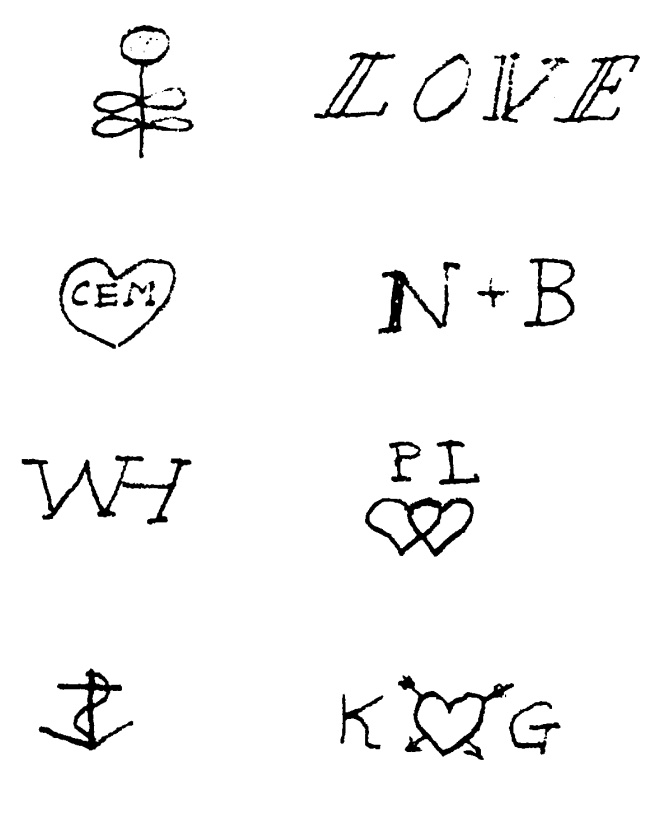
Because clerks wrote tattoos down next to height, complexion, scars and birthmarks,7 the certificates and their applications became a database of everyday tattoos. Two historians did the most to read it: Ira Dye, in "The Tattoos of Early American Seafarers, 1796–1818" (1989), and Simon P. Newman, in "Reading the Bodies of Early American Seafarers" (1998). In Dye's sample, about one in five (20.6%) of American seamen applying for certificates between 1796 and 1803 were tattooed.4 Navy records suggest a similar picture: by the late 18th century, roughly a third of British sailors and a fifth of American sailors had at least one tattoo.2
The designs were mostly personal rather than nautical. Sailors marked their own initials and those of loved ones, important dates, seafaring symbols, liberty poles and crucifixes.7 Newman notes nautical and religious designs, and suggests a crucifix could be meant to secure a Christian burial for a man who died far from home.4 The work was often done at sea by shipmates, with whatever pigment was on hand, including gunpowder and urine.7 By the Civil War, some old hands were covered: in 1862 a sailor on the USS Monitor wrote home that the older men were "regular Picture Books," with coats of arms, American flags and crucifixions.7
The Whaling City, Melville and Queequeg
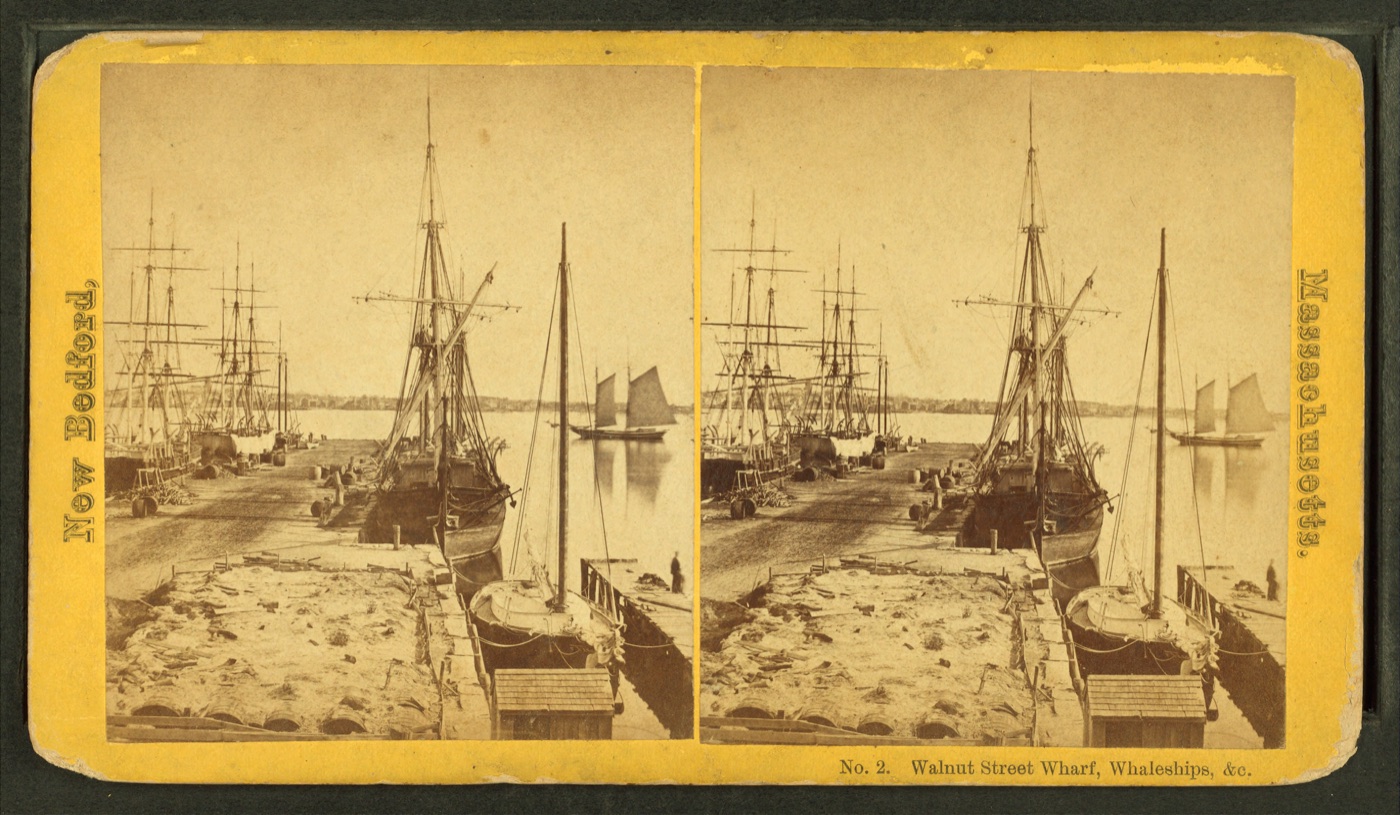
New Bedford passed Nantucket in the number of whaleships sailing each year in 1823 and never gave up the lead. According to the National Park Service, once the railroad arrived in 1840 and opened easier routes to New York and Boston markets, New Bedford became "the wealthiest city in the world."8 Its voyages ran past Cape Horn and the Cape of Good Hope,8 and its crews came from everywhere. In the 18th and early 19th centuries, whalemen were men of African, British and Native American ancestry who had settled around the city. From about 1800, more and more came from the Azores and Cape Verde. More than 3,000 African Americans served on New Bedford whalers between 1803 and 1860. By the 1860s, Portuguese whalemen made up as much as 60% of crews, and after 1900 Cape Verdeans became the backbone of the industry.9
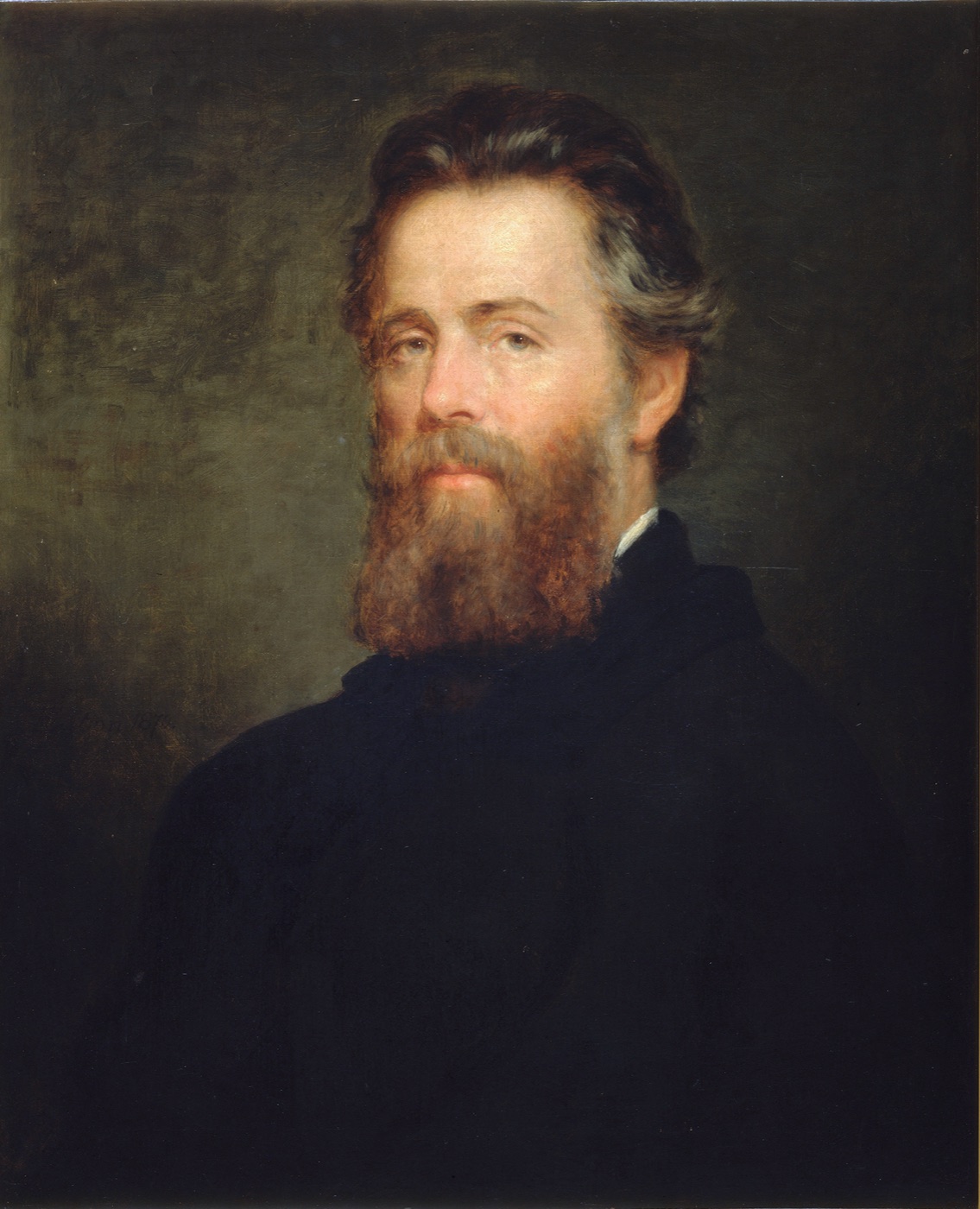
One of the men who shipped out was Herman Melville. He signed on to the whaleship Acushnet on December 30, 1840, and she left New Bedford harbor for the Pacific on January 3, 1841.10 The Acushnet sailed out of Fairhaven, just across the harbor. In July 1842, while the ship was stopped at Nukahiva in the Marquesas, Melville and a shipmate deserted. He wasn't unusual: 11 of the original 26 crew deserted at some point in the voyage.11 Melville lived for a time among the Typee people,12 and his book Typee includes a tattoo artist, Karky, who badly wants to tattoo the narrator's face. The narrator is horrified.13
Tattoos run all through Moby-Dick (1851).12 Its New Bedford chapters may draw on real places like the Seamen's Bethel.10 At the Spouter-Inn, Ishmael gets his first look at the harpooneer Queequeg's face, "here and there stuck over with large blackish looking squares."14 Later, in "Queequeg in His Coffin," Melville describes Queequeg's tattoos as the work of "a departed prophet and seer of his island," amounting to "a complete theory of the heavens and the earth." Queequeg copies parts of the design onto the lid of his coffin.15 These are Pacific tattoo traditions as an American whaleman imagined them, not sailor flash. Still, they show how ordinary tattooed men were on a New Bedford whaler.
What we don't know: we couldn't find a documented tattooer working in New Bedford during the whaling era, and we're not going to invent one. If you know of a logbook entry, letter or photograph that names one, we'd love to hear about it.
From Shipboard Needles to the Port-Town Tattoo Shop
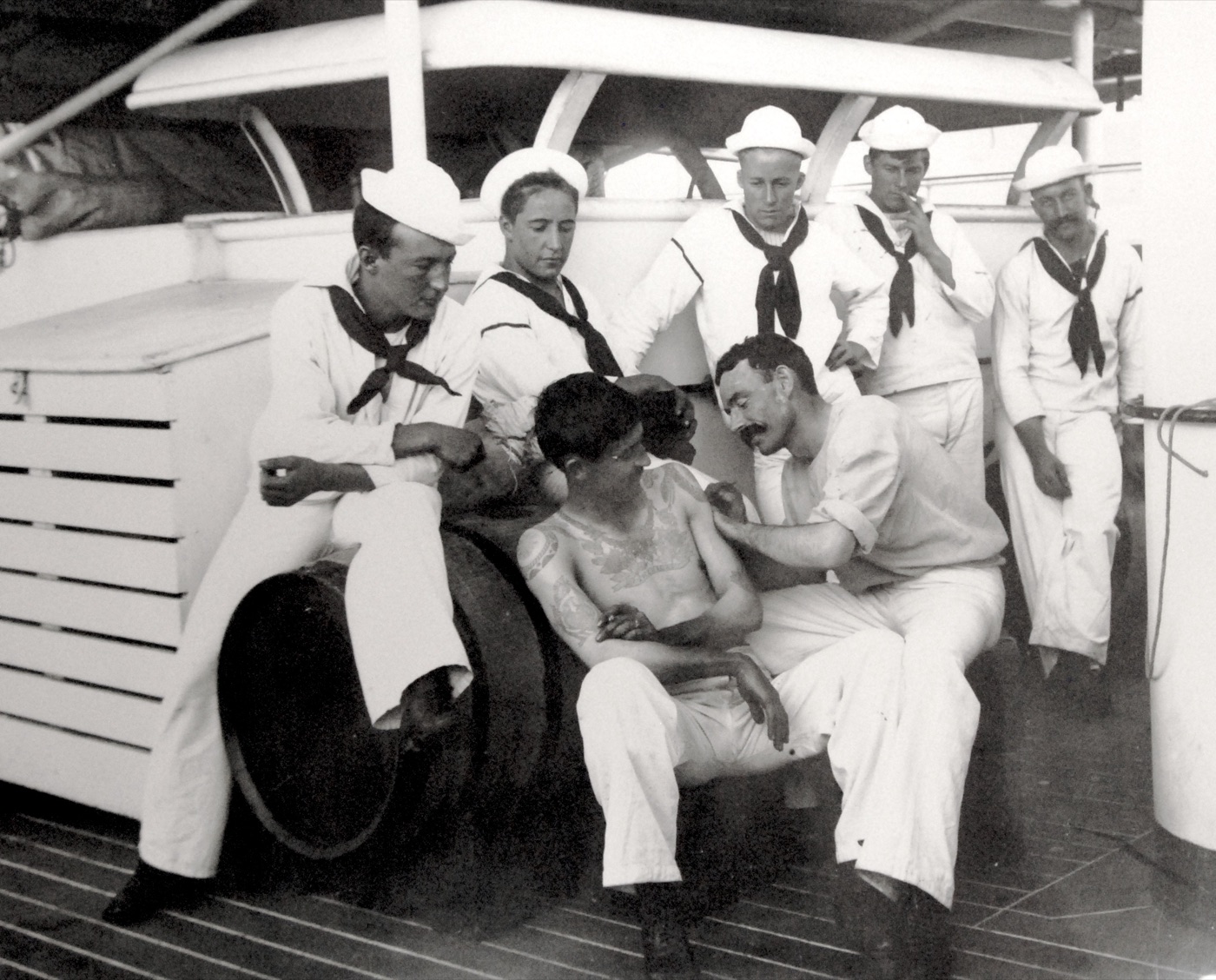
Through the 19th century, tattooing moved from the forecastle to the storefront. The earliest American tattoo parlor is usually credited to Martin Hildebrandt, a German immigrant in lower Manhattan.2 According to research by tattooer and historian Michelle Myles, Hildebrandt started tattooing in 1846 as a sailor aboard the frigate United States and was working in New York by 1859. During the Civil War he went from camp to camp with the Army of the Potomac, and he later told the New York Times he had marked "thousands of sailors and soldiers." Newspaper accounts place him at 77 James Street in 1875 and on Oak Street by 1880.16 Sources disagree on when he opened a permanent shop. Some say the early 1870s, and the details are still being pieced together.416
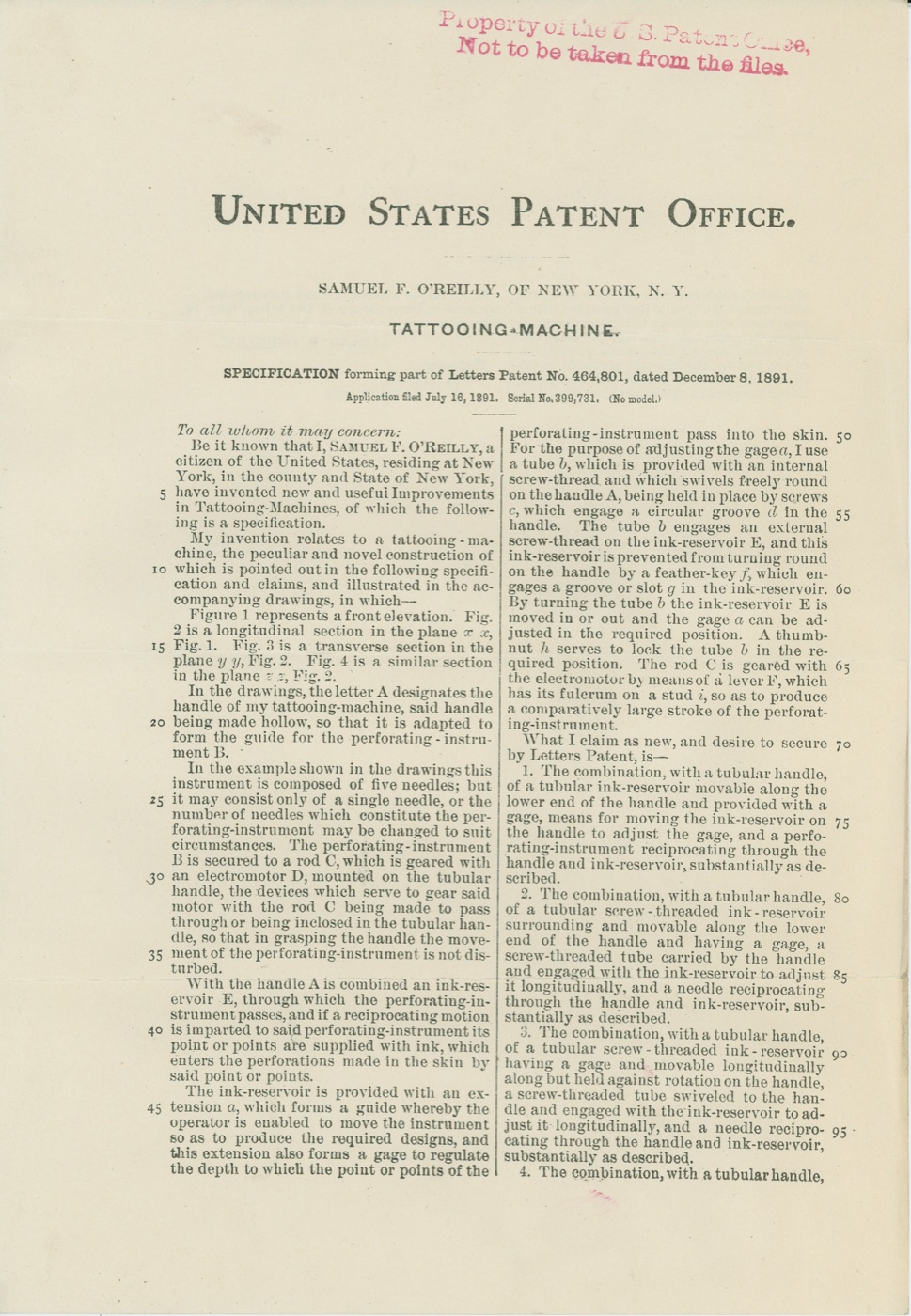
By the 1880s, Matt Lodder says, "most port cities and the large metropolitan areas boasted tattoo artists."2 Then the technology changed. On December 8, 1891, New York tattooer Samuel F. O'Reilly received U.S. Patent No. 464,801 for a "Tattooing-Machine." It was a hollow handle carrying a single needle or a group of five, driven by an electric motor, with an ink reservoir and an adjustable gauge for needle depth.17 O'Reilly's machine adapted Thomas Edison's electric pen.2 It made tattooing less painful and allowed more elaborate designs.7
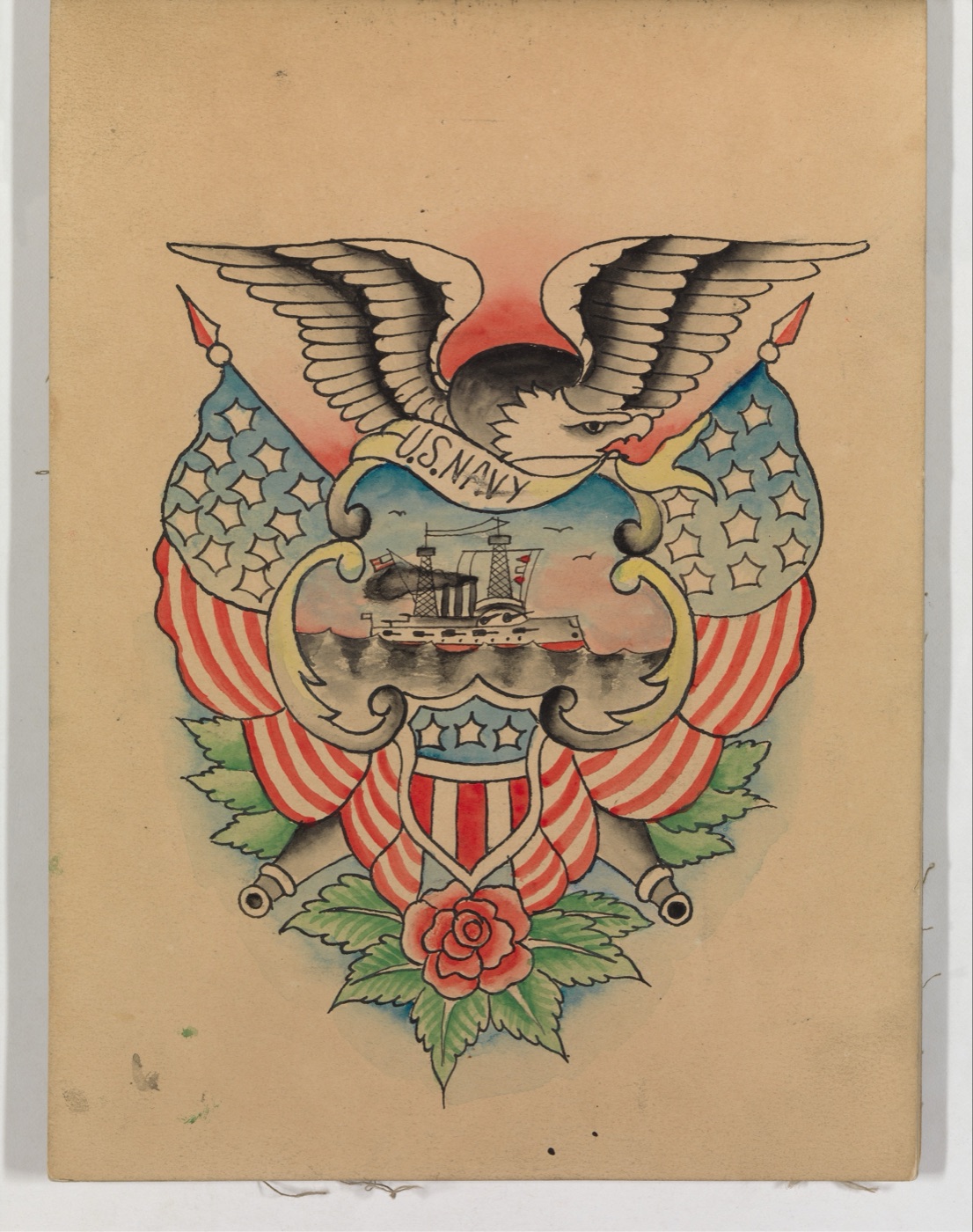
Sailors used the new speed to commemorate. After the sinking of the USS Maine and the Spanish-American War, sailors got tattoos of the Maine. After the Battle of Manila Bay in 1898, some got Commodore George Dewey and his flagship, the USS Olympia. That habit of marking battles carried on through both World Wars.7
World War II and Sailor Jerry
The run-up to World War II caused an unplanned boom in tattooing. A Navy pamphlet required recruits to fix "obscene" tattoos, which mostly meant nude women, so young men lined up to have them covered or "dressed." New York tattooer Charlie Wagner put it plainly: "It's been just like old-home week around here since Pearl Harbor."2
The tattooer most associated with that era is Norman Keith Collins, "Sailor Jerry." According to the Tattoo Archive, he was born January 14, 1911, in Reno, Nevada. In the 1920s he sailed the Great Lakes and tattooed by hand as he traveled, and he credited Tatts Thomas in Chicago as his first teacher in electric tattooing. In Honolulu he worked from addresses on Hotel Street before settling at 1033 Smith Street. He also held captain's papers and hosted a late-night radio show as "Old Ironsides." He died June 12, 1973, and is buried at the National Memorial Cemetery of the Pacific.18
Collins was a Navy veteran who blended American, European and Japanese techniques and styles. Lodder calls him "an incredible draughtsman and artist." He credits Collins with taking 1920s and '30s American tattooing and reworking it into a cleaner, bolder look for the 1950s and '60s, with designs simple enough to "age superbly."2 After his death, Mike Malone bought the shop. In 1999, Malone and Ed Hardy partnered with Steven Grasse to found Sailor Jerry Ltd, which is how his name and flash ended up on rum bottles.194
Sailor Tattoo Meanings: The Record vs. the Lore
Search "sailor tattoo meaning" and you'll find confident lists. Here's what holds up. One thing to keep in mind is that meanings "have often shifted according to context."2
Documented in the historical record
- Initials, names, hearts and dates. These were the most common early designs by far in the protection certificate records.47
- Anchors, ships and other seafaring symbols. They show up in the earliest sketches, alongside a mermaid recorded in 1808.47
- Crucifixes and religious imagery. These were common from the 1790s on, possibly tied to hopes of a Christian burial.47
- Patriotic designs. Liberty poles, flags and coats of arms appear early, and battleships and admirals turn up by 1898.7
- Rating badges. Crossed anchors (boatswain's mates) and crossed cannons (gunner's mates) marked a sailor's specialty.4
Sailor lore: widely told, weakly documented
- Lore: Swallows or bluebirds for every 5,000 nautical miles sailed, or for a safe voyage home. In print, the 5,000-mile version is usually cited to a 1985 source, not to period records.427
- Lore: A pig and a rooster on the feet to prevent drowning. Even the explanations disagree. One says the animals' wooden crates floated when a ship sank. Another says the animals can't swim, so they head straight for shore.20
- Lore: "HOLD FAST" across the knuckles for a better grip in the rigging.2
- Lore: A nautical star or compass to always find the way home. Also crosses on the feet to ward off sharks, and hinges on the elbows against rheumatism.2
Where the evidence pushes back: Dye found that the superstitious designs don't appear in the 1796–1818 protection papers. A study of 310 U.S. Navy sailors from 1885–1889 found no tattooed pigs and no "Hold Fast," and dragon tattoos only appear shortly before World War I.4 Some of these meanings probably did matter to real sailors in the 20th century. But "every sailor in 1800 knew this" is not supported. When you get one today, you're joining a tradition of sailor lore, and that's worth enjoying on its own terms.
How American Traditional Carries It On
What tattooers today call American Traditional grows directly out of this lineage. It uses bold black outlines, a limited, saturated palette and solid shading, with designs readable from across a room. That's the cleaner, bolder look Collins and his generation refined from older sailor work.2 The flash vocabulary of anchors, swallows, ships, roses, eagles, daggers and banners is the same one sailors wore. The reasons it lasts are practical: simple, strong designs hold up as skin ages.
At Whaling City Tattoo Co., traditional work is a big part of what our owner and lead artist Julia Harley does, along with its modern cousin, neo-traditional. Some clients come in for a classic anchor or a swallow. Others want something that's theirs: a ship's name, a grandfather's rating badge, a whale for the city we live in. You can see examples across our styles gallery.
If you're getting your first traditional piece, our first tattoo guide and aftercare instructions cover what to expect before and after.
Sources
Numbered references for the claims above. Links were checked in November 2026. Where we cite an encyclopedia summary of a scholarly article, the original article is named so you can go to it directly.
- David Wilton, "Tattoo," Wordorigins.org. wordorigins.org/big-list-entries/tattoo
- Hunter Oatman-Stanford, "Hello Sailor! The Nautical Roots of Popular Tattoos," Collectors Weekly, December 10, 2012. collectorsweekly.com/articles/the-nautical-roots-of-the-modern-tattoo
- Michael Segalov, "A brief history of the British tattoo" (interview with Matt Lodder), Huck, March 20, 2017. huckmag.com/article/brief-history-british-tattoo
- "Sailor tattoos," Wikipedia, summarizing Ira Dye, "The Tattoos of Early American Seafarers, 1796–1818," Proceedings of the American Philosophical Society 133, no. 4 (1989); Simon P. Newman, "Reading the Bodies of Early American Seafarers," William and Mary Quarterly 55, no. 1 (1998); and B. R. Burg (1995). en.wikipedia.org/wiki/Sailor_tattoos. Dye's article: jstor.org/stable/986875
- "Seaman's Protection Certificate for James Reed, Jr., December 21, 1814," USS Constitution Museum collection. ussconstitutionmuseum.org
- "Sailors – Selections from the Philadelphia Custom House Records," University of Delaware Library, Museums and Press. exhibitions.lib.udel.edu/custom-house
- Catherine McNeur, "The Ink of History" (review of Skin and Bones: Tattoos in the Life of the American Sailor, Independence Seaport Museum / Mystic Seaport), Common-place. commonplace.online/article/the-ink-of-history
- "Whaling Heritage," New Bedford Whaling National Historical Park, National Park Service. nps.gov/nebe/learn/historyculture/whalingheritage.htm
- "Cultural Communities," New Bedford Whaling Museum. whalingmuseum.org
- "Herman Melville," New Bedford Whaling National Historical Park, National Park Service. nps.gov/nebe/learn/historyculture/hermanmelville.htm
- "Herman Melville: A Voyage into History" / Acushnet crew list, Prologue 41, no. 3 (Fall 2009), U.S. National Archives. archives.gov/publications/prologue/2009/fall/melville-acushnet-crew-list
- "January 3, 1841: Herman Melville Sails from New Bedford," Mass Moments, Mass Humanities. massmoments.org
- Herman Melville, Typee: A Peep at Polynesian Life, Project Gutenberg. gutenberg.org/files/28656
- Herman Melville, Moby-Dick; or, The Whale (1851), ch. 3, "The Spouter-Inn," Project Gutenberg. gutenberg.org/files/2701
- Herman Melville, Moby-Dick, ch. 110, "Queequeg in His Coffin," Standard Ebooks. standardebooks.org
- Michelle Myles, "New York's First Professional Tattooer," Daredevil Tattoo blog, January 11, 2016. daredeviltattoo.com
- Samuel F. O'Reilly, "Tattooing-Machine," U.S. Patent No. 464,801, filed July 16, 1891, issued December 8, 1891. patents.google.com/patent/US464801A
- "Norman Keith Collins (Sailor Jerry)," Tattoo Archive (2002, updated 2017). tattooarchive.com
- "Sailor Jerry," Wikipedia (citing Corcoran, Arts+Labor and Austin American-Statesman; Mays; Holmes). en.wikipedia.org/wiki/Sailor_Jerry
- Shannon T. Curley, "What tattoos said about the sailor," Philadelphia Inquirer, April 28, 2009. inquirer.com
Carry the Tradition Forward
Classic sailor flash or a custom piece built on the old vocabulary, drawn and tattooed in the Whaling City. Consultations are free, and walk-ins are welcome Wednesday through Sunday, 11am to 6pm.
Book Your Appointment